
More Than a Sunday School Story: 5 Life-Altering Lessons from the Fields of Moab
- •A temporary "sojourn" away from God can quietly become a permanent address
- •Grief can make us feel judged even while God is working providence we cannot yet see
- •Ruth's loyalty (dâbaq) was a covenant-level commitment, not a convenient one
- •Bethlehem, the "House of Bread," was full again the moment Naomi turned back
- •God's redemption reaches outsiders — Ruth the Moabite is in the lineage of Christ
We often make decisions that we believe are merely temporary—a "shortcut" to navigate a difficult season or a "stop-gap" measure to avoid immediate discomfort. In the moment, these choices seem logical, even necessary. However, history is littered with the wreckage of temporary detours that evolved into permanent trajectories, fundamentally altering the destiny of entire families.
The Book of Ruth opens during the days of the Judges, an era defined by profound spiritual chaos. Following the death of Joshua, a new generation had arisen that "did not know Yahweh nor the work He had done for Israel" (Judges 2:10). It was a period of moral relativism where there was no king, and "everyone did what was right in his own eyes." Into this setting of spiritual decline, we meet Elimelech and Naomi, a couple whose attempt to survive a local crisis led them into a decade of displacement, pagan assimilation, and soul-crushing loss.
By examining Ruth Chapter 1, we find more than a quaint pastoral tale; we find a blueprint for understanding the nature of compromise, the weight of grief, and the radical logic of a devotion that changes the world.
1. The Danger of the "Great Sojourn"
The narrative begins with Elimelech moving his family from Bethlehem to Moab to escape a famine. The text uses two specific Hebrew words to describe their stay, highlighting a subtle but lethal shift in intent.
The guest becomes a resident. Initially, Elimelech went to sojourn. The Hebrew word gûr means "to turn aside from the road" or "stay temporarily as a guest." It was supposed to be a brief visit.
The shift toward permanence. The text later notes that they remained. The Hebrew word is hâyâh. This word means "to exist" or "to become." They were no longer guests; they were assimilated.
The "wicked place" context. This move was a spiritual catastrophe. Moab was an enemy of Israel, a land where the king once hired Balaam to curse God's people. When that failed, the Moabites used seduction and the "abominations" of Baal Peor and their god, Chemosh, to lure Israel into idolatry.
The modern "sojourn." Elimelech's journey is a cautionary tale for us today. We rarely plan to abandon our values; we simply "sojourn" in places we don't belong.
The risk of staying. We sojourn in front of computer screens when no one is watching, or at office parties where the values contradict our faith.
The root of the struggle. Tragically, these short visits often turn into years of sinful struggle. What starts as a temporary stop becomes the place where we "remain."
2. When "Pleasant" Becomes "Bitter"
The name Naomi literally means "Pleasant," but after ten years in Moab, she no longer recognized herself. Following the deaths of her husband and her two sons, Mahlon and Chilion, she experienced a total transformation of identity.
A judicial lament. Upon her return to Bethlehem, Naomi insisted the townspeople call her "Mara," which means "Bitter." She didn't just feel sad; she felt judged. Her language suggests a legal weight, believing the "Almighty" had brought a formal sentence against her.
"I went away full, and the LORD has brought me back empty. Why call me Naomi, when the LORD has testified against me and the Almighty has brought calamity upon me?" (Verse 21)
The irony of perspective. Naomi's lament reveals our human tendency to view God as a judge punishing us, while remaining blind to the providence in motion. While she felt "empty," she was actually returning with a future. Naomi could only see the bitterness of the graves she left behind; she could not yet see that the LORD was "making something beautiful" that would eventually bless the entire world.
3. The Radical Logic of Devotion
When Naomi decided to return to Bethlehem, she urged her daughters-in-law to stay in Moab. Logically, Naomi was right. As widows in a foreign land, Orpah and Ruth had no legal protection. Returning to their mothers' houses offered them the only chance for a "levirate marriage" and security.
Logic versus loyalty. Orpah chose the logical path, returning to her people and her gods. Ruth, however, chose a path of "scandalous" loyalty. The text says Ruth clung to Naomi. This is the Hebrew word dâbaq, meaning "to adhere to" or "hold fast"—the same word used in Genesis to describe the bond between husband and wife.
The "Friend" in the field. Ruth's name actually means "friend," and she lived up to that identity with fierce devotion. While Orpah offered a kiss of goodbye, Ruth offered a life of commitment.
"Do not urge me to leave you or to return from following you. For where you go I will go, and where you lodge I will lodge. Your people shall be my people, and your God my God. Where you die I will die, and there will I be buried. May the LORD do so to me and more also if anything but death parts me from you." (Verses 16–17)
A new allegiance. By swearing an oath in the name of Yahweh, Ruth wasn't just joining a family; she was forsaking the "abominations" of Moab and adopting a new God.
4. The Irony of the "House of Bread"
The geography of this story is thick with irony. Bethlehem literally means "House of Bread," yet the story opens with a famine. Elimelech left the House of Bread to find food in a pagan land, only to find death.
The "Shub" (Turning Back). Naomi's decision to leave Moab is described as a shub—a Hebrew term for turning back, reversing course, or retreating. After ten years of being "away," she chose to reverse the direction her family had taken.
Hidden providence. The timing of this "turning back" was divine. Naomi and Ruth arrived in Bethlehem exactly at the beginning of the barley harvest. After a decade of emptiness in the "fields of Moab," they returned to find the "House of Bread" was full again. This signifies that God's kindness is often waiting for us the moment we decide to turn back toward Him.
5. Redemption is a Foreign Concept
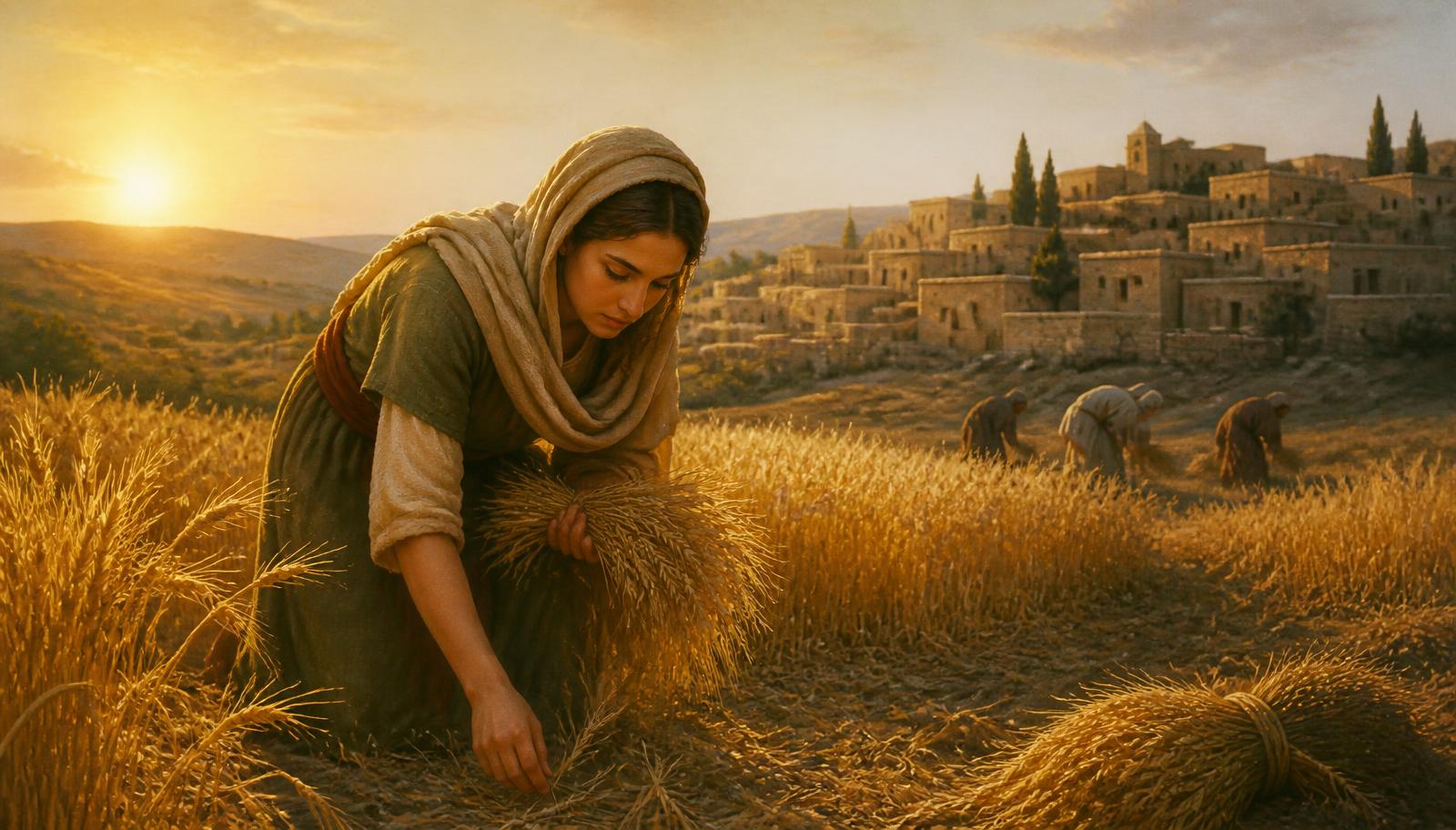
Throughout the text, the author pointedly refers to the protagonist as "Ruth the Moabite." This isn't a slur; it's a theological emphasis. The author wants us to remember that she was an outsider, a foreigner from a cursed lineage.
Inclusion of the outsider. The central themes of this book are kindness and redemption. By highlighting Ruth's foreign status, the narrative proves that God's grace is not restricted by national borders or past mistakes.
The King of kings. The ultimate significance of "Ruth the Moabite" is found in her legacy. This foreign widow is included in the genealogy of Jesus Christ. The small, personal story of a widow gleaning in a barley field connects directly to the Savior. Jesus did not come to reign over a kingdom of dying sinners; He came to die for a kingdom of redeemed saints. He took the "wages of sin" so that outsiders like Ruth—and like us—could be brought home.
Evaluating Our Own Allegiances
The journey from the losses of Moab to the hope of Bethlehem challenges us to examine the current state of our hearts. Naomi returned "empty" but found a harvest; Ruth gave up her security in a pagan land and found a permanent place in the lineage of the Messiah.
Evaluate your current "sojourn." Are you currently lingering in a place—mentally, digitally, or socially—that you don't belong? Maybe your intention was to keep this sojourn brief, but the lures and lies of sin have you remaining there longer than you ever imagined you would. Is your "stay" in a compromise leading you toward or away from your ultimate purpose?
Audit your devotion. If someone were to observe how you spend your time, your energy, and your money, what would they conclude about your allegiances? Ruth did not just speak of loyalty; she demonstrated it through a radical 180-degree turn. The way we live before others is always a reflection of our hearts. Like Ruth, let us be known not for our logical shortcuts, but for what we "cling" to when the path becomes difficult. Are you ready to shub—to turn back toward the House of Bread?
- Where are you currently "sojourning" that you never intended to stay?
- What compromise started as temporary and has quietly become permanent?
- When has bitterness kept you from seeing God's providence?
- What does your calendar and checkbook say about your true allegiance?
- What would it look like for you to shub — to turn back — this week?
Join us for a service
In Fort Myers or Lee County and looking for a church home? Messages like this one are preached every Sunday at 10:30 AM at Daniels Road Baptist Church, with Sunday School at 9:15 AM. Come as you are — we'd love to save you a seat.
Have a question about this passage? Pastor Mike would love to sit down and talk.
Get in touch