The "But Wait, There's More" of Redemption: Surprising Lessons from an Ancient Property Deal
- •True redemption is never a bargain — it is the willingness to embrace a sacrifice
- •The man who protected his name lost it; Boaz, who risked his, is immortalized in the lineage of the Messiah
- •What looks like a profitable deal can become a liability when love enters the contract
- •God's redemptive plan moves through broken and "imperfect" family trees — grace flourishes where we least expect it
- •Boaz the kinsman-redeemer is a shadow of Jesus Christ, who paid the sufficient price for our redemption with His own blood
- •Sacrifice in the "low-stakes" moments of our week makes the Gospel visible to those around us
In the world of 20th-century marketing, few names carried as much weight as Ron Popeil. The "King of the Infomercials" was a master of the pitch, enticing late-night audiences with the Veg-O-Matic, the Pocket Fisherman, and the Showtime Rotisserie. He had a gift for lowering the perceived price until it felt like a steal, only to lean into the camera and deliver his iconic signature: "But wait, there's more!" He understood a fundamental human truth — we are all looking for a high-value return for a low-cost investment. We love a "no-brainer."
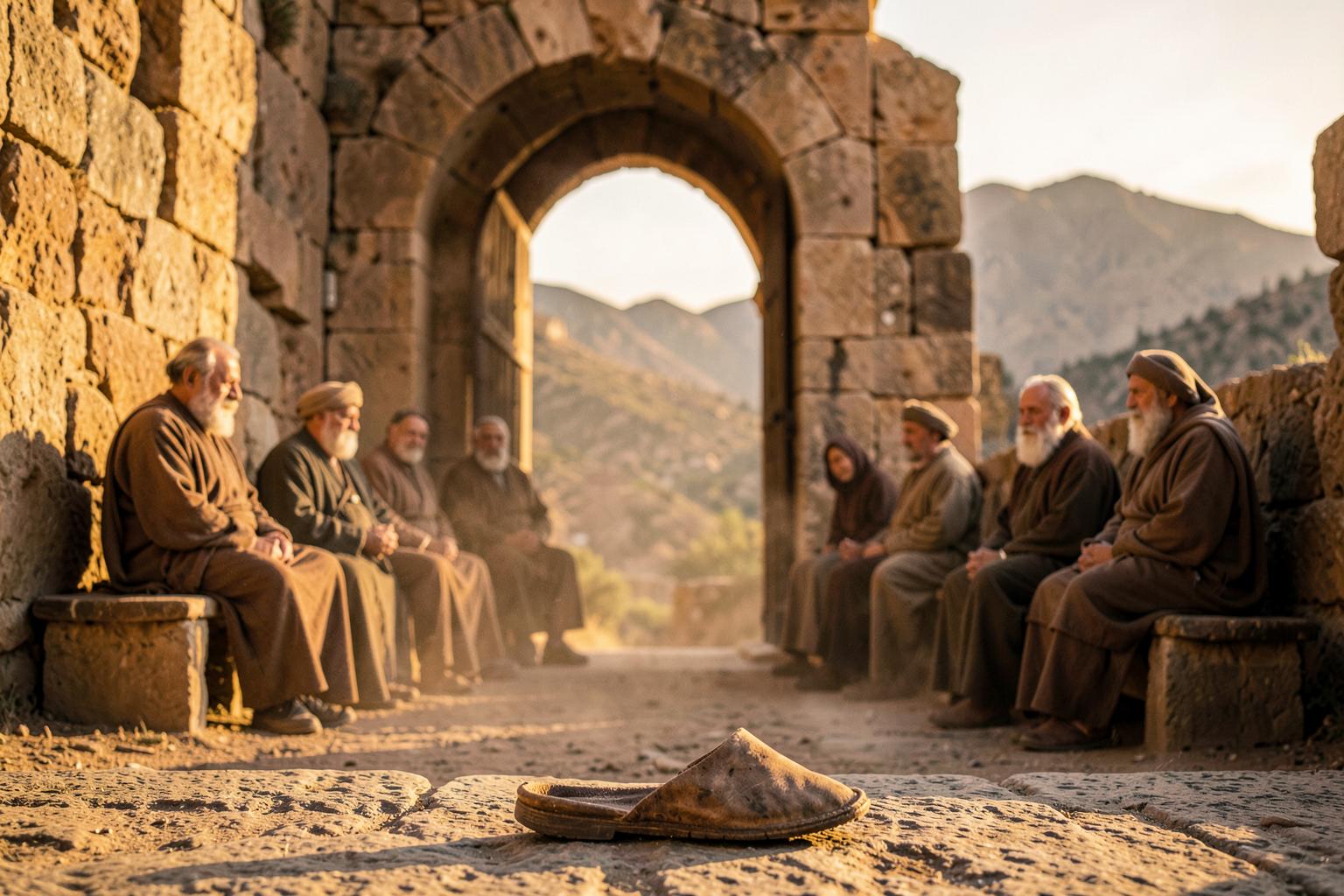
In the fourth chapter of Ruth, we encounter a different kind of negotiator: Boaz. But the setting isn't a television studio; it is the dusty, bustling city gate of Bethlehem. Imagine the atmosphere: the heat of the Judean sun, the low hum of merchants, and the focused attention of ten city elders acting as the ancient equivalent of a public courtroom.
Here, Boaz maneuvers through a complex legal transaction that initially looks like a lucrative business deal for a potential buyer. However, Boaz eventually reveals a hidden cost, proving that true redemption is never about finding a bargain; it is about the willingness to embrace a sacrifice.
1. The High Price of Anonymity
As Boaz sits at the gate, a nearer relative of Naomi's late husband passes by. This man holds the "first right of refusal" to buy back the family land. Interestingly, the narrator of the Book of Ruth refuses to give this man a name, despite his legal standing.
The Hebrew term used is 'almônîy — best translated as "Mr. So-and-so." It is used when revealing a specific name is unnecessary or when a person is destined for obscurity.
There is a biting irony in this linguistic choice. Mr. So-and-so refuses to redeem the land and the widow because he fears "impairing his own inheritance." He is so focused on protecting his name, his wealth, and his family tree that he refuses to help a relative in need.
Consequently, the very thing he tried to protect — his legacy — is wiped out of the story. He remains a nameless "So-and-so," while Boaz, the man willing to sacrifice his wealth and social standing, is immortalized in history.
2. The Lady and the Lad
The negotiation begins with "The Land." Boaz informs Mr. So-and-so that Naomi, having returned as a widow, is selling the field that belonged to her late husband, Elimelech. To Mr. So-and-so, this looks like pure profit. The famine has ended, the harvests are plentiful, and more land means more "shekel signs" in the bank. He views the property as a valuable asset and immediately agrees, saying, "I will redeem it."
But then Boaz delivers his own version of "But wait, there's more." He reveals that the deal includes "The Lady" — specifically, Ruth the Moabite. According to Levirate law, the redeemer must also marry the widow to "raise up the name of the dead."
This revelation changes everything. Because Ruth was a "hated Moabite," bringing her into his home meant inviting social stigma. Furthermore, Mr. So-and-so realizes that any money he invests in the land will eventually go to Ruth's future son — the "lad" who would legally be considered the heir of the deceased Mahlon.
The land he just called an asset was actually a liability to his personal estate. Mr. So-and-so saw that redemption would cost him dearly with no financial upside for his own children, and he quickly backed out.
3. The Scandalous Symbol of the Sandal
When Mr. So-and-so decides the price of kindness is too high, he performs a strange cultural ritual: he pulls off his sandal and hands it to Boaz. While we sign contracts with ink today, this ancient ceremony carried the weight of public identity.
The removal of the sandal served a dual purpose. Symbolically, it meant the man was giving up his right to "tread upon" or claim ownership of the land. However, it also carried a deep social sting. According to the law in Deuteronomy 25, a man who refused to build up his brother's house was to be publicly shamed.
While Ruth was not present to spit in his face — her hopes were already pinned on Boaz — the weight of the refusal remained. Mr. So-and-so walked away with one foot bare, leaving a legacy of selfishness. In the eyes of the community, his household would forever be branded with a shameful nickname: "The house of him who had his sandal pulled off." He chose the comfort of his current shoes over the duty of a redeemer.
4. Grace Flourishes in "Imperfect" Lineages
Once the deal is settled and Boaz claims both the land and the bride, the elders offer a blessing. They pray that Ruth will be like Rachel and Leah, but they also mention a more scandalous name: Tamar.
The mention of Tamar and her son Perez is highly significant. Tamar's story was one of "creativity" born out of desperation because Judah had reneged on his promise to provide her a husband — a direct failure of the very Levirate duty Boaz was currently fulfilling.
The elders highlight this history to show that God's redemptive plan often moves through broken and "imperfect" family trees. Boaz, the son of the tribe of Judah, was now stepping into a messy situation with grace where his ancestors had failed. Because of this sacrifice, Boaz became "renowned," anchoring a lineage that would stretch through the centuries. History records that exactly twenty-nine generations after Boaz made this sacrifice at the gate, his descendant would offer the ultimate redemption.
5. The Ultimate Pivot: Boaz as a Shadow of Christ
The story of Boaz is ultimately a "shadow" of a much greater reality. Boaz was a kinsman-redeemer who used his wealth to save a family, but he points us toward Jesus Christ, the Great Redeemer.
| Feature | Boaz's Redemption | Christ's Redemption |
|---|---|---|
| The Price Paid | Financial wealth and land | His precious blood and perfect life |
| The Motivation | Levirate law and kindness | Divine love for condemned sinners |
| The Result | A son and heir for Mahlon | Eternal life for all who believe |
Boaz used his resources to buy back a field; Jesus used His very life to buy back humanity. Because Jesus was fully human, He could act as our "kinsman." Because He was fully God and sinless, His sacrifice was a sufficient ransom.
The proof of this "sufficient price" is the Resurrection. Death is the wage for sinners, but because Jesus was perfect, death could not hold Him. His rising from the grave validates that the debt of our redemption has been paid in full.
Conclusion: A Call to Sacrificial Living
The story of Ruth 4 challenges us to look at our own lives. Are we living like "Mr. So-and-so," carefully guarding our "inheritance," our time, and our resources to ensure we never "lose out" on a deal? Or are we living like Boaz, who reflected the heart of God through sacrifice?
Reflecting the image of Christ means moving from selfishness to sacrifice in the "low-stakes" moments of our week so that the Gospel becomes visible to those around us. This might look like:
Financial Sacrifice: Giving to a neighbor in need even when it doesn't "make sense" for your monthly budget.
Social Sacrifice: Choosing to sacrifice that exclusive office party to spend time with someone who is marginalized or lonely.
Time Sacrifice: Sacrificing a peaceful evening of rest to invite someone over for dinner and games because they need the company.
When we choose the path of sacrifice over the path of self-protection, we move from the obscurity of "Mr. So-and-so" into the light of God's eternal work. Boaz gave up his wealth and gained a place in the lineage of the Messiah. What are you holding onto today that is keeping you from the joy of redemption?
This week, identify one "low-stakes" moment where you can choose sacrifice over self-protection. It might be financial — giving to a neighbor in need even when it strains the budget. It might be social — passing on something exclusive to spend time with someone marginalized or lonely. Or it might be time — giving up a peaceful evening to invite someone over who simply needs the company.
Don't wait for the big, dramatic opportunity. Redemption was accomplished at a dusty city gate through an ordinary legal transaction. Faithfulness in the small sacrifices is where the Gospel becomes visible.
Finally, if you have never trusted the Great Redeemer, consider what Boaz's shadow points to: Jesus Christ fully paid a debt you could never pay. Come to Him not with a bargain to offer, but with empty hands and a believing heart — His redemption is complete, proven by an empty tomb.
- Why do you think the narrator of Ruth refuses to name the nearer kinsman, calling him "Mr. So-and-so" instead? What warning does his anonymity hold for us?
- Mr. So-and-so backed out when he realized redemption would cost him with no financial upside. When have you been tempted to walk away from obedience because it stopped "making sense" on paper?
- What did the sandal ceremony communicate to the watching community, and what modern-day equivalents mark a public refusal to do what is right?
- The elders' blessing mentions Tamar and Perez — a scandalous chapter in Judah's family tree. How does this encourage you about God's ability to work through your own family's brokenness?
- Comparing Boaz's redemption with Christ's, what does it mean to you personally that Jesus paid a "sufficient price" — and how does the Resurrection prove it?
Join us for a service
In Fort Myers or Lee County and looking for a church home? Messages like this one are preached every Sunday at 10:30 AM at Daniels Road Baptist Church, with Sunday School at 9:15 AM. Come as you are — we'd love to save you a seat.
Have a question about this passage? Pastor Mike would love to sit down and talk.
Get in touch