
Beyond the Schoolyard Rhyme: 6 Surprising Truths from the Story of Ruth and Boaz
- •The playground rhyme gets the order right, but the Book of Ruth shows that real redemption is far more surprising and costly than a simple sequence.
- •Boaz had to "finagle" past a nearer redeemer, proving that love and redemption often require initiative, integrity, and courage.
- •Ruth’s label "the Moabite" disappears at marriage — redemption rewrites identity and belonging.
- •The "honeymoon baby" reminds us that God is the one who appoints and causes life.
- •The women name the baby, not Boaz, as Naomi’s restorer of life, showing that God works through unexpected vessels for long-term restoration.
- •A small-town love story became a covenant link in the royal line from Perez to David — and ultimately to Jesus.
1. The Playground Prophecy
"Johnny and Susie sitting in a tree, K-I-S-S-I-N-G. First comes love, then comes marriage, then comes a baby in a baby carriage."
Most of us can recall this schoolyard chant, a rhythmic ditty used to tease classmates about their first perceived crushes. It posits a linear, sanitized progression of romance: affection leads to legal union, which naturally culminates in the gift of a child. It is the Hallmark template for a "proper" life. Yet, as we approach the conclusion of the Book of Ruth, we find that while the rhyme’s sequence technically holds, the reality is far more complex and "finagled" than a jump-rope rhythm suggests. The story of Ruth and Boaz is not a clinical progression; it is a theological masterpiece of kindness and redemption that defies the simplistic expectations of the playground.
2. The "Finagled" Romance: Love Beyond the Law
While the union of Boaz and Ruth was technically a "levirate" marriage—a legal mechanism designed to preserve the name of a deceased relative—it was anything but a cold, bureaucratic necessity. Boaz did not simply fall into this role; he had to "finagle" his way past a closer relative, the unnamed "Mr. So-and-so," to secure the right to redeem Naomi’s land and take Ruth as his wife.
This was a romance built on the bedrock of character rather than mere convenience. Boaz’s protective spirit and Ruth’s loyalty to her mother-in-law created a mutual admiration that transcended the requirements of the law. As the narrative suggests, their love was fueled by a recognition of shared virtue:
She had seen the godliness and kindness of Boaz… she had been comforted by his words… trust me, there was all manner of reasons for Ruth to love Boaz and for Boaz to love Ruth.
3. Identity Restored: From "The Moabite" to "The Wife"
One of the most striking social transformations in the biblical text is the linguistic shift regarding Ruth’s identity. Five times throughout the narrative, she is explicitly labeled "Ruth the Moabite." In the cultural context of Bethlehem, this was no neutral descriptor; the Moabites were "hated enemies," ethnic outsiders viewed with deep suspicion and historical animosity.
When the text finally declares, "So Boaz took Ruth," a radical act of social redemption occurs. The moniker "the Moabite" is abruptly dropped. Through legal recognition and covenantal marriage, her status as a "hated enemy" is dissolved, and she is fully integrated into the community as "the wife." This removal of a derogatory label highlights the power of redemption to rewrite a person’s social standing and future.
4. The Miracle of the "Honeymoon Baby"
The arrival of a son in Ruth 4 is presented as a direct, divine intervention. The text employs the Hebrew word nāthan, which means "to appoint or assign; to bestow or grant; to cause." This choice of vocabulary emphasizes that "the LORD gave her conception."
This theological detail is vital when contrasted with Ruth’s history. During her decade-long marriage to Mahlon, she remained childless. The sudden conception of a "honeymoon baby" with Boaz underscores the biblical perspective that God is the ultimate "cause" of life. This grounds the "pro-life" stance not in political theory, but in the belief that if God is the one who bestows and assigns life, humanity has a sacred obligation to protect and celebrate it as a miraculous gift.
5. The Counter-Intuitive Redeemer: Why the Baby Came First
In a fascinating turn of events, the women of Bethlehem identify the newborn infant—not Boaz—as Naomi’s primary redeemer. This reveals a profound truth about long-term restoration.
The Child as the Restorer of Life
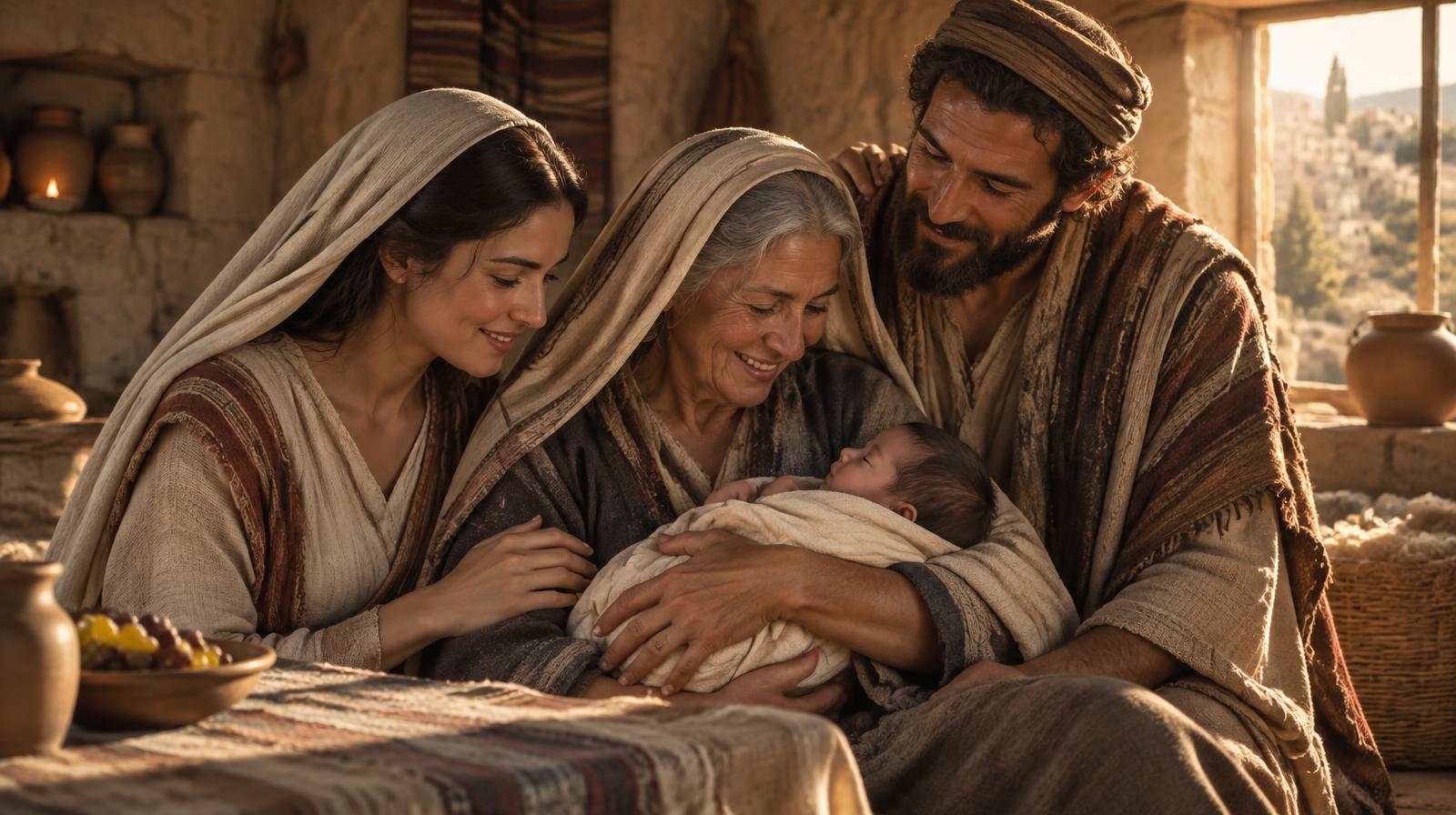
Boaz acted as the kinsman-redeemer in a legal sense, providing immediate stability. However, Boaz was an older man whose protection was, by definition, temporary. The women recognized that the child, Obed (whose name literally means "to serve"), was the true "restorer of life." He was the one who would provide for Naomi in her old age, acting as a 'āman—a term meaning "to build up or support." While Ruth was the biological mother, Naomi became a "nurse" or foster parent, finding her "empty" life refilled by a grandson who would serve her and ensure her family name did not vanish into history.
6. The "Better Than Seven Sons" Paradox
In the ancient Near East, the number seven symbolized perfection, and having seven sons was the pinnacle of cultural success and security. Yet, the neighborhood women offer a blessing to Naomi that shatters these traditional gender and cultural hierarchies:
Blessed be the LORD, who has not left you this day without a redeemer, and may his name be renowned in Israel! He shall be to you a restorer of life and a nourisher of your old age, for your daughter-in-law who loves you, who is more to you than seven sons, has given birth to him.
By claiming Ruth was "better than seven sons," the community acknowledged that her foreign devotion was more valuable than the "perfect" number of biological Israelite heirs. Her loyalty provided a level of security and love that tradition alone could never guarantee.
7. The Long Game: From a Lap to a Lineage
The book of Ruth concludes with a "Registry" that connects a small-town act of kindness to the cosmic scale of history. The genealogy lists exactly ten generations, a structure that intentionally mirrors the registries of Noah (Genesis 5) and Abraham (Genesis 11). In biblical literature, these ten-generation structures signify the establishment of a divine covenant.
| Generation | Name |
|---|---|
| 1 | Perez |
| 2 | Hezron |
| 3 | Ram |
| 4 | Amminadab |
| 5 | Nahshon |
| 6 | Salmon |
| 7 | Boaz |
| 8 | Obed — the one who "serves" |
| 9 | Jesse |
| 10 | David |
This structure proves that the infant sitting on Grandma Naomi’s lap was the grandfather of King David. More importantly, it establishes the royal lineage of Jesus Christ. The story of Ruth is not just a local romance; it is a vital link in the covenantal chain leading to the Messiah.
Conclusion: Redemption in the Everyday
The story of Ruth and Boaz reminds us that redemption is not merely an abstract theological concept; it is practiced in the mundane. Boaz redeemed with legal integrity; Ruth redeemed with fierce devotion. Ultimately, their story points us toward Jesus, the "Son of David," who did not come to reign over dying sinners, but to die for redeemed saints, purchasing our restoration not with land or grain, but with His own blood.
We are called to mirror this redemption in our own lives through active devotion. Redemption today often looks like the "small" things: children honoring parents, husbands serving wives, and church members visiting the lonely or encouraging new believers.
How can you be a "restorer of life" in your own family or community this week?
Application: Be a Restorer of Life This Week
Redemption is not reserved for grand gestures. This week, ask the Lord to show you one ordinary way to reflect His restoring love:
- Children: Honor and obey your parents without argument or delay. - Husbands: Demonstrate love through service — do the dishes, take out the trash, listen well. - Church Members: Visit the lonely or encourage someone new to the faith.
When we practice these small acts, we join the long line of ordinary people through whom God writes His redemption story.
- Where do I still see people (or myself) defined by old labels rather than by a redeemed identity in Christ?
- How does viewing children as a gift from the LORD change the way I think about life and family?
- Who in my life needs a "restorer of life" right now, and what small kindness could I offer?
- How does the Ruth-to-David genealogy deepen my appreciation for Jesus as the ultimate Redeemer?
- What "everyday" act of devotion can I do this week to mirror God's redemption?
Join us for a service
Messages like this one are preached every Sunday at Daniels Road Baptist Church in Fort Myers. Come as you are — we'd love to save you a seat.
Have a question about this passage? Pastor Mike would love to sit down and talk.
Get in touch